

While oil prices get all the headlines and refineries are earning record free cash flows fueled by historically high crack spreads, there is another adjacent energy bull market that is still under the radar of most. RIN prices have reached almost their all-time high.
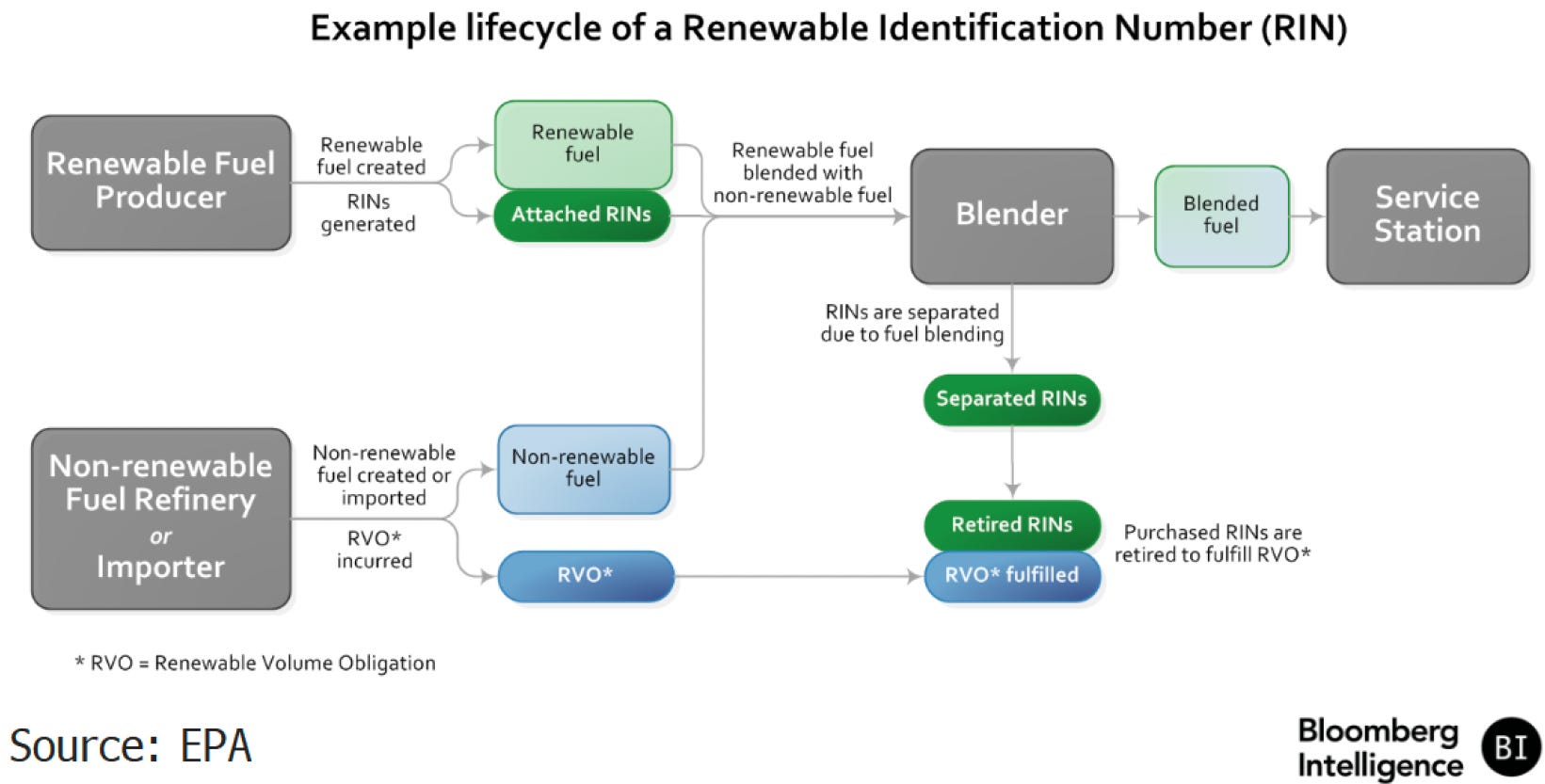
RIN stands for Renewable Identification Number. The way the credit market works is that every renewable diesel/biofuel gallon generates a set amount of RINs. Refiners must meet a minimum number of RINs, either by generating the biodiesel themselves or by purchasing them from a renewable producer.
In March this year the EPA finalized a new set of blending mandates for the renewable market, the so-called "Set 2" rule, which covers 2026 and 2027. The higher blending rates (RVO) are the main driver behind the higher RIN prices. Set 2 targets roughly 5.4 billion physical gallons of biomass-based diesel in 2026 and 5.7 billion in 2027, which the EPA itself estimates requires a 60% step-up in domestic production versus 2025.
This higher blending mandate, and the step-change in production it requires, will most likely result in not enough RINs in circulation. In recent years there was a surplus of RINs; too much renewable diesel was produced and traditional refineries had an easy time meeting their requirements. That oversupply is now shrinking, and the RIN bank is depleting rapidly.
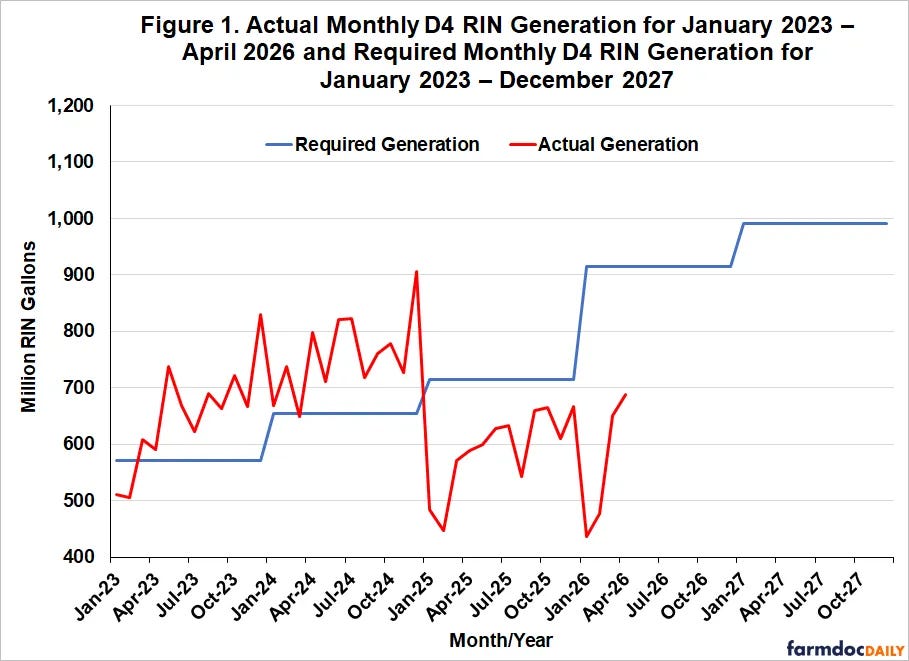
“The cumulative shortfall through the first four months of 2026 is 1.411 billion RIN gallons relative to the pro-rata required pace, or about 13 percent of the entire annual requirement. Closing that early-year gap would require monthly D4 net RIN generation over the remaining eight months of 2026 to average 1.092 billion RIN gallons, a pace more than 20 percent above the highest single month ever recorded.”
- Rewriting the RFS Playbook: The Impact of Final RVOs on Projected Biomass-Based Diesel Production and Imports for 2026-2027 (Link)
The BOHO spread (Bean Oil-Heating Oil) is the price difference between soybean oil and heating oil. This spread is usually taken to determine the profitability of biodiesel. RINs normally trade in correlation with it, meaning the higher the BOHO spread, the higher RIN prices need to be to fulfill the mandate and incentivize biodiesel production. The lower the spread, the less RIN price support is needed. Right now, however, we are not only close to all-time highs in RIN prices, they have also decoupled from the BOHO spread.
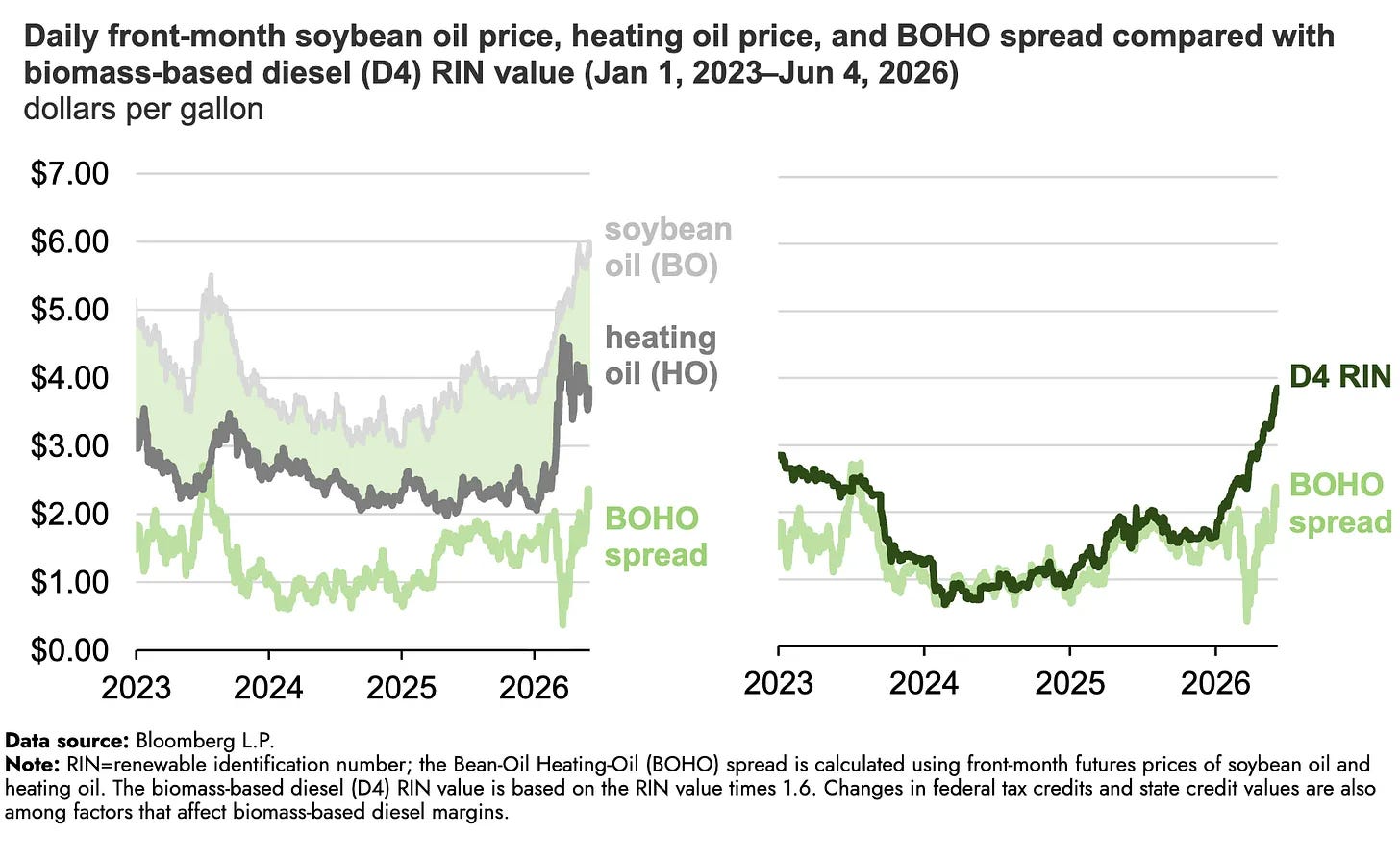
A clear sign of a demand/supply imbalance in the market: the blending targets require a material step-up in renewable diesel demand.
The market, at the very least, needs every idle gallon of biodiesel capacity running at nameplate. And June’s RIN generation numbers did in fact show a surprising, material uplift in biodiesel and renewable diesel production. More than 839.14 million D4 biomass-based diesel RINs were generated in June, compared to 735.78 million in May. This step-up in production reduces the tail-risk scenario on both sides. RIN prices will likely not go completely parabolic, as production is picking up faster than analysts would have expected. But it equally reduces the risk of waivers from the EPA, as the market shows it can (somewhat) handle the higher blending mandate, and the goal of the policy, to incentivize and increase domestic biodiesel and renewable diesel production, is working.
But even at those levels, the RIN bank (the number of “unused RINs”) is running out, and is projected to be in a very tight spot by the end of the year and going into 2027.
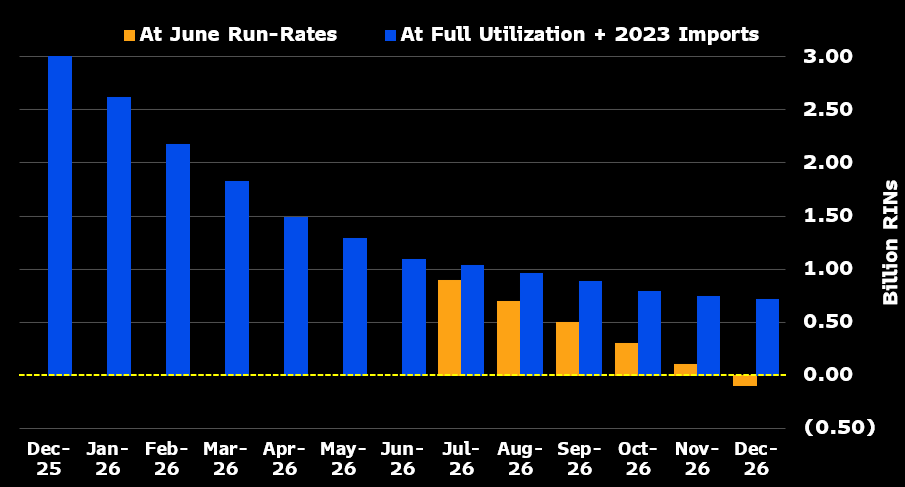
I recommend following Brett Gibbs, renewable fuel analyst at Bloomberg.
The current supply/demand picture for RINs points to structurally higher prices, and at the current RIN price of roughly $2.40, biodiesel and renewable diesel production is already very profitable.
The question, therefore: how do we make money off that?
I have one stock for you that Wall Street seems to be sleeping on. While most of the names benefiting from higher RIN prices have already re-rated quite a bit, this one has barely done so. It’s under the radar, $200M market cap, no earnings calls, very few press releases, no debt, low downside, two segments, one of them exposed to the RIN prices.
I believe this one represents a great opportunity once Wall Street discovers how much they are currently earning.